
06 · One possible future · feasibility study
Healthcare.
The Care District.
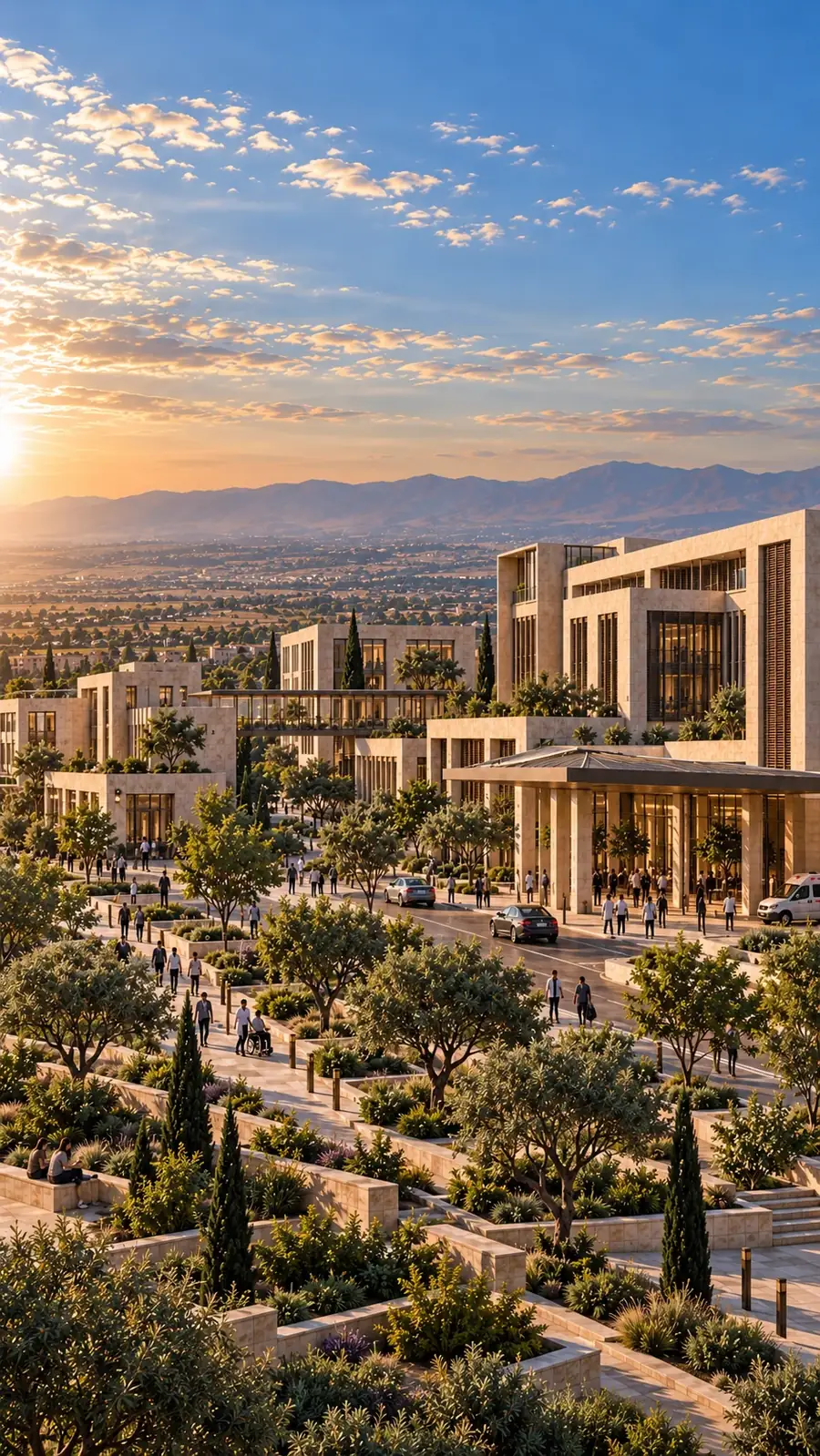
A 350-bed general hospital, specialist centres, outpatient diagnostics and staff housing in a healing landscape — an institutional medical district for a capital that must rebuild its hospitals, studied to feasibility level.
THE IDEA
A hospital the city
can trust again.
Damascus must rebuild both its hospitals and its trust in them. The Care District study proposes an institutional medical campus rather than a single building: a 350-bed general hospital at the centre, specialist centres for oncology, cardiac care and rehabilitation beside it, outpatient clinics and diagnostics on the highway side where ambulances and day patients arrive, staff housing and a training school at the quiet northern end, and healing gardens between all of them.
The site suits the use. Ambulances reach it from the whole southern and eastern city without crossing the centre; a helipad and the airport ten kilometres away serve emergency transfer and, later, regional patients; and ten hectares gives the one thing city hospitals never have — room to grow in place.
Healthcare is operator-led. The study is written for a regional hospital group, a Gulf healthcare investor, a foundation, and the development-finance institutions that fund hospitals in reconstruction markets — and it proposes a ground lease as the route that fits all of them.
WHY NOW
Demand that
does not wait.
Health facilities are among the most damaged public infrastructure in the World Bank’s US$216BN reconstruction assessment; 15.6 million people are counted as in need of assistance. Since December 2024 more than 3.3 million refugees and internally displaced Syrians have returned, and returnees name health services among the conditions of coming home. Those who can afford care travel to Beirut or Amman for it; the capital of a country of 24 million has no modern tertiary hospital built to international standard on a site that can expand.
Healthcare is one of the few uses whose demand does not depend on the pace of the wider recovery — it is the recovery. Sanctions relief has reopened access to medical equipment, international operators and development finance; card payments returning in 2026 make regional medical tourism possible for the first time in fifteen years.
WHY THIS PARCEL
Five reasons
an operator would choose it.
- Access for ambulances. Highway frontage reachable from Jaramana, Sayyida Zainab and the whole south and east of the city without entering the centre.
- Room to grow in place. Ten hectares: a hospital can add wings and centres for thirty years without moving.
- Quiet and air. Open land seven kilometres out; a healing landscape is possible here and impossible in the city.
- Transfer and tourism. A helipad on site; the airport ten kilometres away for regional patients and visiting surgeons.
- One title. Long-term institutions need certainty of tenure; a single registered property held by one owner provides it.
THE PROGRAMME
What the land
would hold.
| Component | Indicative scale | Note |
|---|---|---|
| General hospital | 350 beds · 40,000 m² GFA · 5 floors | Emergency, surgery (10 theatres), ICU, maternity, paediatrics, imaging, labs |
| Specialist centres — oncology, cardiac, rehabilitation | 15,000 m² GFA · 3 floors | Phased; linked to the hospital |
| Outpatient clinics and diagnostics | 10,000 m² GFA · 3 floors | Highway side; day patients and emergency access |
| Staff housing and training school | 10,000 m² GFA · 4 floors | Nursing school, 200 staff units; northern end |
| Healing gardens, courtyards | ≈ 35,000 m² | Roughly a third of the site |
| Parking | ≈ 1,200 bays | 800 at grade, 400 basement |
| Helipad, ambulance bay, service yard | Included | Emergency transfer |
| Gross floor area above ground | ≈ 75,000 m² GFA | Plot ratio ≈ 0.75 · 3–5 storeys — to be tested against zoning and Ministry of Health licensing |
Indicative programme for discussion. Bed numbers, clinical mix and heights must be tested against Ministry of Health licensing, the national hospital plan and current zoning before any figure is relied on.

INDICATIVE MASTERPLAN
One hospital,
a garden around it.
The parcel outline is the source-derived presentation diagram of the supplied survey; the blocks are indicative and drawn for discussion. Phase 1: hospital, outpatient, emergency, utilities, gardens. Phase 2: specialist centres. Phase 3: staff housing and training.
THE ROUTES
Three ways
this can be done.
Operator acquires and builds.
A hospital group buys the land and builds and equips its own flagship on an expandable freehold.
Long ground lease.
PETRA retains the land and leases it for 40–50 years to an operator or foundation that builds and runs the district. The operator’s capital goes into beds, not land; PETRA holds an indexed income and the reversion.
Public–private partnership.
The Ministry of Health or a development-finance institution contracts the hospital as a PPP: a private consortium builds and operates against availability and service payments; PETRA contributes the land as equity or on a ground lease into the consortium. The model international lenders know.
WHAT THE OPERATOR GETS
The case
for a hospital group.
- The flagship of a market re-opening. The first international-standard tertiary hospital in the capital sets the reference for a country of 24 million.
- Land that costs beds nothing. Under the ground-lease route the operator’s capital goes entirely into buildings and equipment.
- Room to grow for thirty years. Specialist centres, a second tower, a medical school — all inside the same title.
- Access and transfer. Ambulances from the whole south-east of the city; a helipad; the airport ten kilometres away for regional patients.
- Finance that fits. Development-finance institutions fund hospitals in reconstruction markets; the PPP route is the one they already know.

RISKS AND MITIGANTS
What could
go wrong.
| Risk | Mitigant |
|---|---|
| Ministry of Health licensing and the national hospital plan | Engage the Ministry first; align bed numbers and clinical mix with the plan; the PPP route makes the Ministry a partner rather than a gatekeeper. |
| Operator and clinical staffing | Partner with a regional hospital group with a training pipeline; the on-site nursing school; diaspora physicians returning. |
| Payer mix is untested | Phase one sized at 350 beds; mix of private, insured and contracted public patients. |
| Power, water and medical-gas resilience | N+1 generation, rooftop PV, water storage and treatment, on-site medical-gas plant — included. |
| Medical equipment cost and import | Operator-funded; sanctions relief reopens supply; phased procurement. |
| Construction cost inflation | Lump-sum packages for MEP and theatres; phased build. |
| Political and compliance risk | Counterparty screening; DFI participation; international arbitration; political-risk insurance. |
SOURCES
Where the figures
come from.
- World Bank, Oct 2025 — Syria Physical Damage and Reconstruction Assessment: US$216BN; health facilities among the most damaged public infrastructure. ↗
- UNHCR Syria Operational Update, March 2026 — over 1.5M refugees and 1.8M IDPs returned since Dec 2024; returnees cite health services as a condition of return. ↗
- UNHCR / USA for UNHCR, July 2026 — health facilities damaged or overstretched; 15.6M people in need of assistance. ↗
- The National, 26 Aug 2026 — visitor arrivals 3.52M in H1 2026; international card payments returning (medical-tourism precondition). ↗
- Arab News, 12 May 2026 — first Syrian-UAE Investment Forum; Gulf interest across services and infrastructure. ↗
- U.S. Department of State — comprehensive sanctions revoked June 2025; Caesar Act repealed December 2025 (medical equipment and finance access). ↗
Nothing on this page is an offer or investment advice. Independent legal, planning, clinical, technical and financial review is required.
FOR HOSPITAL GROUPS, FOUNDATIONS AND DFIs
Read the full
feasibility study.
The asset, the corridor, the market, the programme, the masterplan, three deal routes including a ground lease, risks and the diligence sequence.