04 · One possible future · feasibility study
Hospitality.
The Pause.
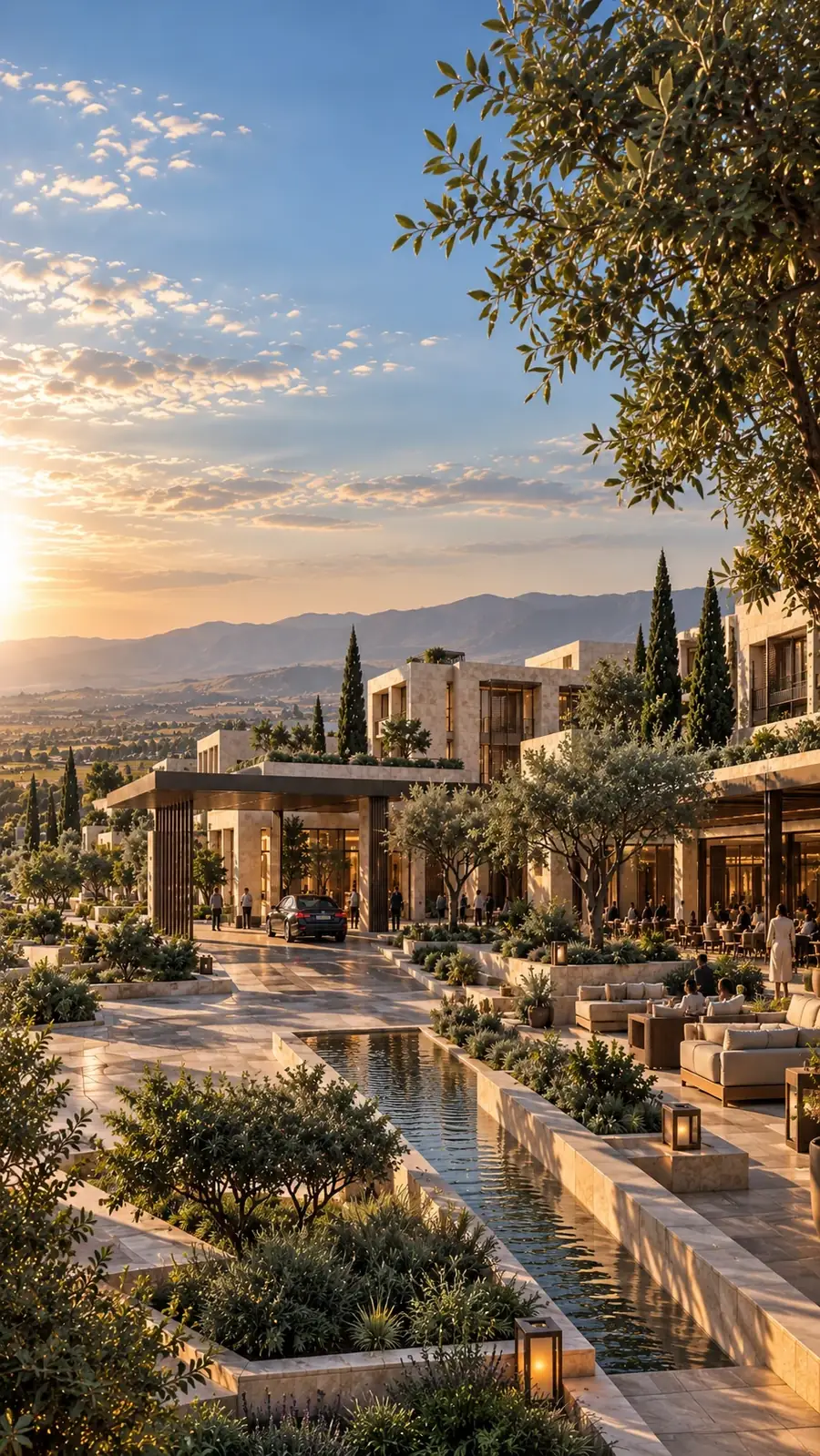
A 250-key upscale garden resort in low-rise wings around courtyards, with 80 branded residences, a ballroom and a spa — ten minutes from the airport, ten from the old city, studied to feasibility level for operators and hospitality investors.
THE IDEA
Arrival, shade,
courtyard and stay.
Arrivals into Syria more than doubled in the first half of 2026. The Pause study places a hotel where arriving guests first need one — ten minutes from the airport, ten from the old city — on land large enough for gardens, courtyards and water rather than a tower on a plinth.
The architecture is Damascene rather than generic: three low-rise wings of rooms around a walled garden with pools at its heart, a spa in the courtyard, a ballroom and conference wing at the arrival, and eighty branded residences in three clusters at the quiet northern end. The resort reads as a destination for weddings, delegations and regional weekends, not only as an airport hotel — and the residences, sold to diaspora and Gulf buyers, fund a large part of the hotel.
The study is written for international and regional hotel operators, Gulf hospitality groups and family offices that want an operating flagship in the capital rather than land.
WHY NOW
Arrivals doubled.
The rooms did not.
Visitor arrivals reached 3.52 million in the first half of 2026, up from 1.67 million a year earlier, as flights and card payments returned. The demand mix is delegations, investors and contractors first; diaspora families visiting and holding weddings and reunions second; regional leisure third. The upscale stock they find in Damascus is old, small and in the city; there is no resort-style hotel between the airport and the centre, and no branded residences.
A US$4BN airport programme is announced ten kilometres away. PETRA does not control it and the Pause does not depend on it — current arrivals support a 250-key hotel — but when it lands, this is the first resort on the road in.
WHY THIS PARCEL
Five reasons
an operator would choose it.
- Ten minutes either way. From the airport for arriving guests; to the old city for what they came to see.
- Room for a garden. Ten hectares: pools, courtyards, lawns and walled gardens — the resort experience no city site in Damascus can offer.
- Weddings and events. A ballroom with gardens around it, four kilometres from the Exhibition Centre, in a culture whose largest celebrations are outdoors.
- Residences that pay for rooms. Eighty branded residences on the quiet edge, sold to diaspora and Gulf buyers who want a serviced home in the capital.
- One title, open land. One signature; nothing to demolish; a name can be announced the day the deal signs.
THE PROGRAMME
What the land
would hold.
| Component | Indicative scale | Note |
|---|---|---|
| Hotel — upscale, 4–5 star | 250 keys · 26,000 m² GFA · 3 storeys | Three wings around a walled garden; restaurants, lounges, pool bar |
| Branded residences | 80 units · ≈ 14,400 m² sellable | Three low-rise clusters at the northern end; hotel-serviced; sold |
| Ballroom and conference wing | 4,000 m² GFA | 1,000-guest ballroom, garden terraces, meeting rooms; at the arrival |
| Spa and wellness | 3,000 m² GFA | Courtyard position; hammam, treatment rooms, gym |
| Pools, gardens, sports, courts | ≈ 40,000 m² | Landscape as the amenity; roughly 40% of the site |
| Parking | ≈ 600 bays | At grade, screened by planting, either side of the arrival |
| Gross floor area above ground | ≈ 47,000 m² GFA | Plot ratio ≈ 0.47 · 2–3 storeys — to be tested against zoning and tourism licensing |
Indicative programme for discussion. Keys, residence mix and heights must be tested against current zoning, Ministry of Tourism licensing and an operator’s brand standard before any figure is relied on.

INDICATIVE MASTERPLAN
Three wings,
one garden.
The parcel outline is the source-derived presentation diagram of the supplied survey; the blocks are indicative and drawn for discussion. Phase 1: hotel, ballroom, spa, gardens. Phase 2: residences.
THE NUMBERS
What it costs
to build.
| Cost item | Basis | US$ |
|---|---|---|
| Hotel, 26,000 m² GFA | US$1,150 / m² — including FF&E to operator standard | 29,900,000 |
| Branded residences, ≈ 17,000 m² GFA | US$900 / m² — fitted | 15,300,000 |
| Ballroom and conference wing, 4,000 m² GFA | US$1,000 / m² | 4,000,000 |
| Spa and wellness, 3,000 m² GFA | US$1,200 / m² | 3,600,000 |
| Pools, gardens, sports, landscape | US$110 / m² over ≈ 40,000 m² | 4,400,000 |
| Parking, roads | 600 bays at grade | 900,000 |
| Utilities | Substation and grid connection, water and storage, sewage treatment and reuse, fire, telecoms | 4,500,000 |
| Professional fees and permits | 8% of hard cost | 5,010,000 |
| Contingency | 10% of hard cost | 6,260,000 |
| Development cost, excluding land | ≈ US$1,570 per m² GFA | 73,870,000 |
Unit rates are 2026 benchmarks for Jordan, Egypt and the Gulf with an allowance for import conditions in Syria; the hotel rate includes furniture, fittings and equipment. Excludes operator pre-opening and key money, finance costs, taxes and VAT. All figures are indicative and pre-design.
THE RETURN
Three ways
this can be done.
The study assumes 250 keys at an average rate of US$150 and 60% occupancy at stabilisation, total revenue 1.6 × rooms revenue (a resort earns from food, events and spa), and a 30% net margin after management fees and FF&E reserve — mid-range against Amman and well below Beirut and the Gulf. Hotel net operating income at base: ≈ US$3.9M a year. The 80 residences sell for about US$31.7M, which reduces the capital left in the hotel to ≈ US$68M all-in, or ≈ US$43M of cash construction cost where the land is contributed as equity.
Operator group acquires and builds.
A Gulf or regional hospitality group buys the land at the asking price and builds its Damascus flagship under its own brand, selling the residences to fund a third of the project. It owns a freehold resort at ≈ US$323,000 per key all-in, net of residence sales.
Land-as-equity with an operator.
PETRA contributes Property No. 14 at the asking price as ≈ 25% equity in the owning company; a hospitality investor funds construction; an international operator manages under a management agreement. Residence sales return capital early; PETRA holds a share of a flagship hotel.
Residences first.
Phase the residences ahead of the hotel: 80 branded units sold off-plan against a signed operator brand fund the hotel’s construction. Lowest capital at risk; the brand is announced on day one and the hotel opens on the residence proceeds.
| Average rate · occupancy | Hotel revenue | Hotel net operating income | NOI on all-in cost net of residence sales (US$68M) | NOI on cash cost land as equity, net of residences (US$43M) |
|---|---|---|---|---|
| US$120 · 55% | US$9.6M | US$2.9M | 4.2% | 6.7% |
| US$150 · 60% · base | US$13.1M | US$3.9M | 5.8% | 9.1% |
| US$180 · 65% | US$17.1M | US$5.1M | 7.5% | 11.9% |
Stabilised (year 3–4), unlevered, after management fees and FF&E reserve. Hotels are 20-year assets whose rates rise with the destination; the airport programme is upside not in the base. There is no Damascus benchmark; the sensitivity is the point of the table, and an operator’s own underwriting should replace it.
WHAT THE OPERATOR GETS
The case
for a hotel group.
- The flagship of a market re-opening. The first resort hotel in the capital, on the road every visitor travels — a brand statement for a group entering Syria.
- Residences that fund rooms. Eighty branded units sold to diaspora and Gulf buyers return a third of the capital before opening.
- Weddings and events. A garden ballroom in a culture of large outdoor celebrations; four kilometres from the Exhibition Centre.
- Low-rise, fast, no height risk. Two and three storeys under the airport approach; pools and gardens instead of towers.
- A partner, not just a landlord. PETRA is prepared to take equity rather than cash, cutting day-one capital by a quarter.

RISKS AND MITIGANTS
What could
go wrong.
| Risk | Mitigant |
|---|---|
| Zoning and Ministry of Tourism licensing | Confirm permitted use and tourism classification first; the low-rise scheme sits comfortably under airport height limits. |
| Rate and occupancy are untested | Management agreement with an international operator before construction; the operator’s underwriting replaces the study; residences reduce capital at risk. |
| Residence sales absorption | Brand signed before launch; 80 units is a small release; diaspora and Gulf demand for serviced homes in the capital; escrow for deposits. |
| Water for a landscape-heavy resort | On-site treatment and reuse for irrigation, water storage, native planting; capacity letters before commitment. |
| Power reliability | Rooftop PV, battery back-up, N+1 generation — a resort must never go dark. |
| Construction cost inflation and FF&E import | 10% contingency; phased build; fixed-price packages for FF&E and MEP. |
| Political and compliance risk; targeted sanctions remain | Counterparty screening; international arbitration; political-risk insurance where available. |
SOURCES
Where the figures
come from.
- Syria Ministry of Tourism via The National, 26 Aug 2026 — visitor arrivals 3.52 million in H1 2026, up from 1.67 million; international card payments returning. ↗
- AP / Syrian Investment Authority, 6 Aug 2025 — US$4BN Damascus International Airport programme, up to 31M passengers a year. ↗
- Arab News, 12 May 2026 — first Syrian-UAE Investment Forum; tourism named among target sectors. ↗
- SANA, 29 Aug 2026 — 63rd Damascus International Fair, ~1,000 entities from 60 countries. ↗
- UNHCR, March 2026 — over 3.3M refugees and IDPs returned since Dec 2024; diaspora visits and family events. ↗
- U.S. Department of State — comprehensive sanctions revoked June 2025; Caesar Act repealed December 2025. ↗
Cost, rate and sales figures are PETRA study assumptions built from regional benchmarks; they are not quotations or a valuation. Nothing on this page is an offer or investment advice. Independent legal, planning, technical and financial review is required.
FOR HOTEL OPERATORS AND HOSPITALITY INVESTORS
Read the full
feasibility study.
Thirteen pages: the asset, the corridor, the market, the programme, the masterplan, the development budget, hotel economics, three deal routes with sensitivities, risks, and the diligence sequence.