03 · One possible future · feasibility study
Retail +
Offices.
The Exchange.
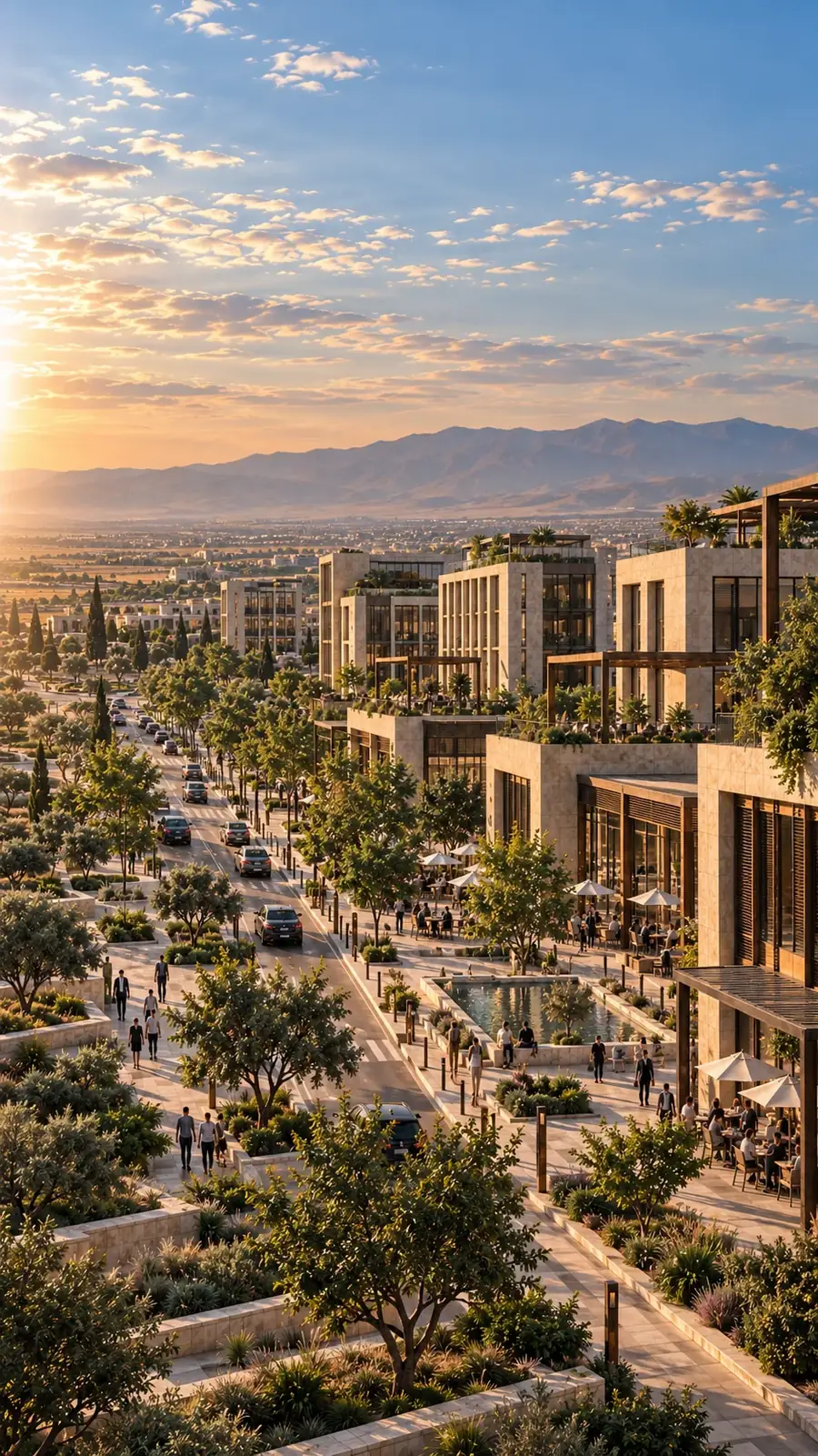
Four low-rise Grade A office courts, showrooms with highway frontage, a conference hall and a retail street — the business address of the corridor for companies re-entering Syria, studied to feasibility level.
THE IDEA
The business address
of the corridor.
The Exchange treats the airport road as what it is becoming: the business address of the capital. Four low-rise office courts of three to five storeys around shaded gardens; showrooms with highway frontage for the cars, furniture and building materials a reconstruction needs; a conference hall four kilometres from the International Exhibition Centre; and a retail street down the middle that makes the district worth staying in after five o’clock.
Companies re-entering Syria need offices that meet international standards — fire, IT, standby power, compliance — and that a visiting executive can reach from the airport in ten minutes. Almost none exist. The Exchange is built for that gap, and built low so that it can be delivered court by court and sold or leased in pieces.
The study is written for a commercial developer or business-park operator, for a consortium of companies that need Damascus headquarters and prefer to own, and for showroom operators who want the corridor’s frontage.
WHY NOW
The companies
are coming back.
Twelve agreements worth US$14BN were signed in Damascus in August 2025; the first Syrian-UAE investment forum followed in May 2026; forty Turkish companies came to a Damascus business forum this summer and a thousand exhibitors from sixty countries filled the International Fair in August. Every one of those companies needs an office, and most of the contractors and suppliers behind a US$216BN reconstruction need a showroom.
The stock they find is old city-centre buildings, converted apartments and villas. There is no business park in the capital and no Grade A office on the corridor. The first one sets the rent.
WHY THIS PARCEL
Five reasons
a developer would choose it.
- Frontage. 110 metres on the airport highway — the showroom address every distributor in Damascus wants and none can find at scale.
- Ten minutes from the airport, ten from the ministries. The two places a business visitor must reach.
- The Exhibition Centre next door. Four kilometres away; a conference hall here extends the fair season into a year-round venue.
- One title, divisible product. One signature to buy; then courts and showrooms that can be sold or leased individually, which makes the project financeable in phases.
- Open land. Nothing to demolish or relocate.
THE PROGRAMME
What the land
would hold.
| Component | Indicative scale | Note |
|---|---|---|
| Office courts A–D — Grade A, 3–5 storeys | 40,000 m² GFA · ≈ 34,000 m² lettable | Floorplates of 1,200–2,000 m² around shaded gardens; sold or leased by court |
| Showrooms — highway frontage | 12,000 m² GFA | Automotive, furniture, building materials; plots sold or leased individually |
| Conference and exhibition hall | 8,000 m² GFA | 1,500-seat hall, breakout rooms; operator-leased |
| Retail street, dining, services | 10,000 m² GFA · ≈ 8,500 m² lettable | The spine between the courts |
| Parking | ≈ 1,800 bays | 1,000 at grade, 800 in basement under the courts |
| Gardens, streets, courts | ≈ 30,000 m² | Shade and the life between buildings |
| Gross floor area above ground | ≈ 70,000 m² GFA | Plot ratio ≈ 0.7 · 3–5 storeys — to be tested against zoning |
Indicative programme for discussion. Heights and plot ratio must be tested against current Rural Damascus zoning and highway setback rules before any figure is relied on.

INDICATIVE MASTERPLAN
Four courts,
one street.
The parcel outline is the source-derived presentation diagram of the supplied survey; the blocks are indicative and drawn for discussion. Phase 1: showrooms, retail street, courts A–B. Phase 2: courts C–D and the hall.
THE NUMBERS
What it costs
to build.
| Cost item | Basis | US$ |
|---|---|---|
| Office courts, 40,000 m² GFA | US$700 / m² — Grade A shell and core, Cat A floors | 28,000,000 |
| Showrooms, 12,000 m² GFA | US$550 / m² — shell, glazed frontage | 6,600,000 |
| Conference hall, 8,000 m² GFA | US$900 / m² — long-span, fitted | 7,200,000 |
| Retail street, 10,000 m² GFA | US$600 / m² — shell, shaded arcade | 6,000,000 |
| Parking | 1,000 at grade at US$60 / m² · 800 basement at US$300 / m² | 9,180,000 |
| Streets, gardens, landscape | US$80 / m² over ≈ 30,000 m² | 2,400,000 |
| Utilities | Substation and grid connection, water, sewage treatment, fire, telecoms | 4,500,000 |
| Professional fees and permits | 8% of hard cost | 5,110,000 |
| Contingency | 10% of hard cost | 6,390,000 |
| Development cost, excluding land | ≈ US$1,077 per m² GFA | 75,380,000 |
Unit rates are 2026 benchmarks for Jordan, Egypt and the Gulf with an allowance for import conditions in Syria. Excludes tenant fit-out, finance costs, taxes and VAT. All figures are indicative and pre-design.
THE RETURN
Three ways
this can be done.
The Exchange is an income asset with a sellable edge. The study assumes offices at US$200 per m² a year, showrooms at US$150, the retail street at US$280 and the conference hall at a net operator lease of US$75 per m², all at 85–90% occupancy — mid-range against Amman and Cairo, with no Damascus benchmark because no comparable stock exists. Stabilised net operating income at base: ≈ US$9.1M a year, tested at 80% to 120%. The showroom plots could instead be sold at about US$1,500 per m² (≈ US$18M), which is Route C.
Developer acquires and builds.
A developer buys the land at the asking price, builds in two phases and holds a business park on the corridor — or sells courts individually to the companies that occupy them.
Land-as-equity joint venture.
PETRA contributes Property No. 14 at the asking price as equity — about 25% of all-in cost. A developer and a financial partner fund construction; courts pre-let or pre-sold before each phase. PETRA holds a share of a stabilised income asset.
Sell the edge, hold the core.
Showroom plots sold to distributors up front (≈ US$18M at US$1,500 / m²) to fund the retail street and the first courts; the developer holds the offices and the hall. Lowest capital at risk; the frontage is monetised on day one.
| Income vs base | Net operating income | Yield on all-in cost US$100.4M | Yield on cash cost land as equity, US$75.4M | Value at 8.5% cap |
|---|---|---|---|---|
| 80% | US$7.3M | 7.2% | 9.6% | US$85M |
| 90% | US$8.2M | 8.1% | 10.8% | US$96M |
| 100% · base | US$9.1M | 9.0% | 12.0% | US$107M |
| 110% | US$10.0M | 9.9% | 13.2% | US$117M |
| 120% | US$10.9M | 10.8% | 14.4% | US$128M |
Net operating income is stabilised (year 3), unlevered, after non-recoverable costs. The Damascus market has no comparable evidence; the sensitivity is the point of the table.
WHAT THE PARTNER GETS
The case
for a developer.
- Divisible product. Four courts, a row of showroom plots, a hall: each can be pre-let, pre-sold or held. The project finances itself in pieces.
- The frontage. 110 metres on the airport road — the only showroom address of its kind on the corridor.
- Pre-let demand that already exists. The companies signing agreements in Damascus this year are the tenants; the fair four kilometres away is the conference hall’s calendar.
- Low-rise, fast to build. Three to five storeys, no tower cores, no airport height risk.
- A partner, not just a landlord. PETRA is prepared to take equity rather than cash, cutting the developer’s day-one capital by a quarter.

RISKS AND MITIGANTS
What could
go wrong.
| Risk | Mitigant |
|---|---|
| Zoning does not permit commercial use, or highway-frontage access is restricted | Confirm permitted use and access consent first; showroom plots redesigned as offices if frontage access is refused. |
| Office rents on the corridor are untested | Pre-let 40% of each court before it starts; sell courts to owner-occupiers where leasing is slow; wide sensitivity in this study. |
| Competing supply in central Damascus as reconstruction advances | Differentiate on standard, parking and airport access; deliver first. |
| Power reliability for office tenants | 100% standby generation, rooftop PV on the courts, dual telecom feeds — Grade A means it works when the grid does not. |
| Conference-hall utilisation | Operator lease with a fair-season anchor; hall designed for exhibitions, weddings and corporate use. |
| Construction cost inflation and import conditions | 10% contingency; phased build; fixed-price packages for façades and MEP. |
| Political and compliance risk; targeted sanctions remain | Counterparty screening; international arbitration; political-risk insurance where available. |
SOURCES
Where the figures
come from.
- Reuters / Arab News / Al Jazeera, 6 Aug 2025 — 12 investment agreements totalling US$14BN signed in Damascus across infrastructure, transport and real estate. ↗
- Arab News, 12 May 2026 — first Syrian-UAE Investment Forum in Damascus; UAE groups exploring tourism, infrastructure, logistics, services and industry. ↗
- SANA, 29 Aug 2026 — 63rd Damascus International Fair, ~1,000 entities from 60 countries; Damascus–Turkish business forum with 40 Turkish companies. ↗
- The National, 26 Aug 2026 — international card payments returning; visitor arrivals 3.52M in H1 2026. ↗
- World Bank, Oct 2025 — Syria reconstruction estimate US$216BN. ↗
- U.S. Department of State — comprehensive sanctions revoked June 2025; Caesar Act repealed December 2025. ↗
Cost and rent figures are PETRA study assumptions built from regional benchmarks; they are not quotations or a valuation. Nothing on this page is an offer or investment advice. Independent legal, planning, technical and financial review is required.
FOR DEVELOPERS, OPERATORS AND OWNER-OCCUPIERS
Read the full
feasibility study.
Thirteen pages: the asset, the corridor, the market, the programme, the masterplan, the development budget, the income model, three deal routes with sensitivities, risks, and the diligence sequence.